Artist: A Hai
Curator: He Yongmiao
Academic Advisor: Yang Jian
Venue: Renke Art, No. 1 North Zhongshan Road, Gongshu District, Hangzhou
A Hai is one of the most significant ink wash artists in contemporary China. Centering on brush and ink with paper as his medium, he deconstructs the conventions of traditional gongbi (meticulous brushwork) to reconstruct order, thereby achieving a dual transformation of ink wash and gongbi and realizing a contemporary reinterpretation of his work. A Hai’s paintings strike a delicate balance between the refinement of gongbi and the unrestrained spontaneity of xieyi (freehand brushwork)—outwardly maintaining the elegance of gongbi, while inwardly conveying the emotional tension unique to xieyi. This style has been categorized by critics as a form of "Southern Narrative." Its tone is aesthetic, decadent, and nihilistic, expressing a wanderer’s nostalgia and tribute to a spiritual homeland. Among the recent works on display, his still life and landscape themes are particularly innovative. These pieces gradually depart from the surrealist narrative style of his earlier years, dissolving dramatic contrasts and eschewing diversity, conflict, and historical-cultural references. They reflect a mindset characteristic of midlife: neither ostentatious nor restrained, neither exaggerated nor humble. The compositions capture the imagery of decay in nature while also mirroring inner melancholy and solitude.

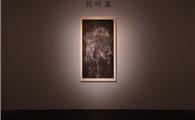
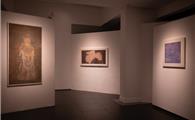
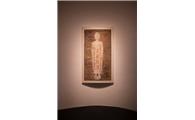
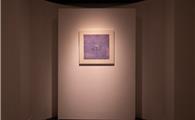


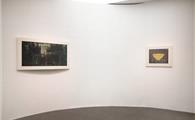


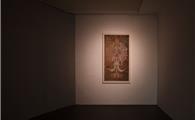
The Sorrow of Flowers
By Yang Jian
A Hai’s art is connected to sublime beauty and profound elegance, ideals that have always lingered, albeit subtly, in our traditional art. In contemporary art, A Hai is almost the only artist cultivating these realms. While the rest of us have moved away from sublime beauty and profound elegance, A Hai alone uses his flowers to express moments of utmost brilliance and the impending dimming of that brilliance—all enveloped in sublime beauty and profound elegance.
A Hai has recreated sublime beauty and profound elegance. In his art, nothing is more critical or essential than these ideals; they are almost the soul of his work, most prominently manifested in his floral paintings. Within this ambiance, his flowers, though vibrant and luxuriant, may very well be embodiments of extreme clarity and humble observers. Do not assume they are truly immersed in vibrancy and luxury.
A Hai’s flowers are, in essence, the sorrow of time. They are not merely blossoms but the embodiment of sensitivity, acuity, emotion, and perception of the era’s most distinguished minds. His flowers serve no other purpose than to bid farewell and depict withering, yet he renders them with a sense of eternity. When I think of Qian Xuan, I am reminded of A Hai’s flowers. Qian Xuan never painted without wine, and A Hai finds no joy without it. A man so immersed in worldly pleasures surprisingly bears the countenance of a peony or an iris. Thinking of A Hai brings to mind the peonies and irises he paints. When he depicts them, he also captures their disappearance. He employs all his technical prowess to portray the world’s most beautiful, resplendent, and luxurious flowers—ones that seem almost impossible to exist. Yet, to me, he is merely painting disappearance. That disappearance is so beautiful, so luxurious, so impossible, that he feels compelled to capture it. Thus, A Hai becomes the artist of our time who records beauty, luxury, and transience. His flowers are not about indulgence but intoxication; not barrenness but opulence. Within them lies a shared sorrow, where intoxication and transcendence coexist in a single blossom.
Most importantly, the colors in A Hai’s flowers are distinctly Chinese. For reasons unknown, one glance at them leaves an indelible mark. They are ethereal and elusive, as if their very existence is meant to be so. Yet, they are tangibly present before your eyes, preserved on xuan paper with reverence. They are so luxurious, so beautiful, that you can only lower your head, hesitant to look again, yet unable to resist. You yearn to imprint this nobility and beauty firmly in your heart. Because it is entirely and purely Chinese, it naturally strikes a chord within you—your heartstrings, your inner eye—which have long been absent from such Chinese colors, beauty, and luxury. This is a long-awa homecoming—a return to the homeland of our colors, our elegance, and our opulence.
First snow and old snow, youth and old age, mono no aware and remembrance, abandon and restraint, the highest and the lowest, literati and knights, loss and victory, this life and this world, past and history—all are encapsulated in those flowers. The delicate essence of the flowers, fine as a gossamer thread, is etched onto the paper. Each piece is a remembrance of things past, a rebirth of beauty and luxury. He paints the final visage of flowers, for the original blossoms are no more. Sorrow—sorrow of such purity—is maternal, humble. The fragile flower and the eternal flower appear simultaneously on the canvas. So fragile, thus eternal, permeated and preserved by a breath from the Song Dynasty.
A Hai is a slice of our rapidly declining era, a perfect amalgamation of contradictions. Yet, deep within him, a balance is precisely maintained. It turns out A Hai’s original surname is Kong, linking him directly to our sage through lineage. In China, bearing the surname Kong is profound, yet he changed his name to A Hai. None of us knew he was originally a Kong. A Hai’s flowers bloom from black and white; he is a man versed in both extremes. This is his own contradiction, the most fundamental one, from which all subsequent contradictions arise. Yet, he handles it so masterfully, transforming this contradiction into the most moving and luxurious flowers of our time. This is because he has absorbed all of life’s bittersweet experiences. He never speaks of suffering or art; in our ears, only his uniquely mature laughter resonates. A Hai loves to laugh; scarcely a few minutes pass without his laughter. In his fully ripened laughter, no one remains untouched by joy.
Someone once asked A Hai, "Do you paint luxurious flowers or ordinary ones? Are they flowers of evil or of goodness?" A Hai replied, "All four."
On this ever-evolving planet, A Hai has painted a flower of yin softness. This flower, since its inception, has not faded nor turned gray with age. He paints it as a commemoration of primordial time. Within this elegant and understated remembrance lies a faint, almost vanishing sorrow of the literati—a sorrow that has appeared in the flowers of Qian Xuan, Xu Wei, Yun Shouping, and Chen Hongshou, in the flowers of Su Manshu, and now reappears in A Hai’s flowers. Only, compared to the sorrow in the flowers of previous dynasties, it is more mottled, more intense and沉重, more urgent, yet also more serene and captivating.
A Hai—
A Hai—
A Hai—
"Ah" is the childhood of each of us; "Hai" is our forgetting and remembering.
In that realm of right and wrong, good and evil, light and darkness, a man named A Hai has painted a luxurious Chinese flower for every one of us.
October 25, 2025
Artist Profile
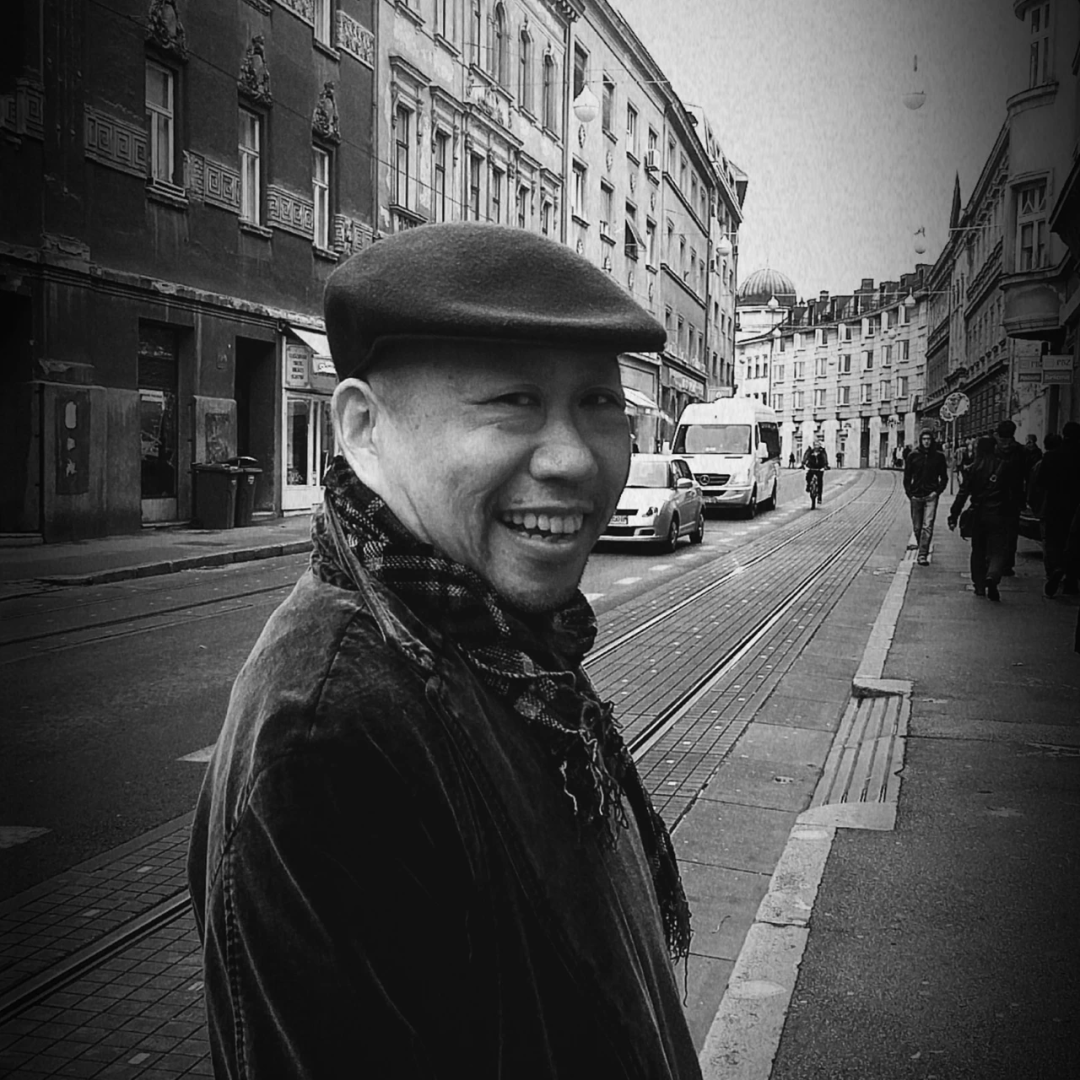
Born in 1963 in Nanjing, China;
Graduated from the Chinese Painting Department of Nanjing University of the Arts in 1989.
